Tool for proxy-pool design

Behavioral Domain Atlas

Explore and select behavioral proxies

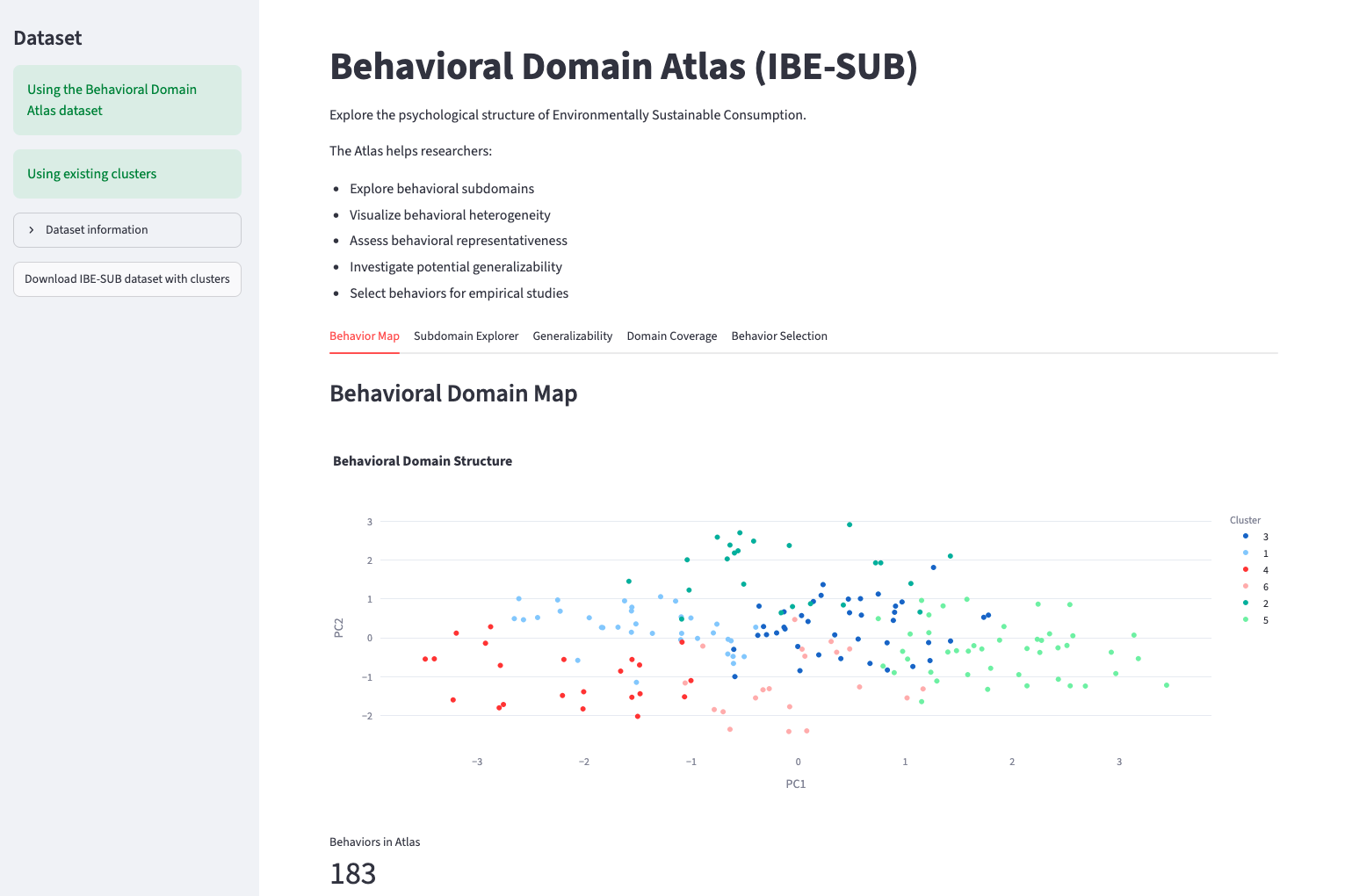
The Behavioral Domain Atlas is an interactive tool that helps researchers explore how environmentally sustainable consumption behaviors differ in their psychological characteristics and select proxies for empirical research.

183mapped behaviors
5broader dimensions
6descriptive subdomains
Behavioral Domain Atlas interface showing the behavioral map

Three ways to use the Atlas

Explore behavioral differences

Explore how behaviors differ in assessed psychological characteristics.

Assess behavioral coverage

Examine which parts of the behavioral domain are represented by a selected set of proxies or by behaviors used in previous research.

Select proxies

Use random sampling, purposive sampling, or matched pairs to select behavioral proxies that fit your research goals.

The current Atlas is an ESC application

The general multi-proxy approach is not limited to environmental behavior. The current Atlas focuses specifically on environmentally sustainable consumption (ESC), mapping the psychological characteristics of behaviors within this domain and providing tools for selecting proxies.

Why a behavioral map can help

Suppose you want to test whether an experimental effect depends on a behavioral characteristic such as normativity. Simply choosing behaviors that seem to differ in normativity may introduce other differences at the same time, such as effort or moral conviction. The Atlas allows you to examine these characteristics together, helping you select proxies more systematically and identify potential confounds.

The research question comes first

The Atlas helps researchers explore and select behavioral proxies, but it does not determine which selection strategy is most appropriate. That decision depends on the specific research question and the goals of the study.

Keep the distinction clear: Multi-proxy experimentation is an experimental approach. The Atlas is a tool for exploring behavioral differences and selecting proxies for both multi-proxy and conventional experiments.

← Back to Proxy pools